
Winter Walks in Britain: Frost, Fog and Unforgettable Scenery
There is a particular kind of beauty that only reveals itself when the temperature drops. Frost tracing the veins of a fallen leaf. Fog settling into a valley so that only the hilltops remain, floating like islands. The crunch of frozen ground underfoot on a path you have entirely to yourself. Winter walking in Britain and Ireland is not about endurance or extremes. It is about seeing familiar landscapes transformed into something altogether more atmospheric, more cinematic, more honest.
Britain and Ireland in winter offer something that surprises many first-time visitors: extraordinary walking, often in complete solitude, through scenery that rivals anything you will find in summer. The crowds thin out, the light becomes low and golden, and the hills take on a rawness that photographs simply cannot capture. You have to be there, breathing the cold air, to understand.
This guide covers ten of the finest winter walks across Britain and Ireland, along with practical advice on staying safe, packing the right kit, and making the most of the shorter days. Whether you are drawn to the frosted ridges of the Scottish Highlands or the dramatic coastal cliffs of Dorset, there is a winter walk here that will stay with you long after you have warmed up by the fire.
Why Walk in Winter?
Before you lace up your boots, it is worth understanding what makes winter walking in Britain so rewarding.
The landscape changes character completely. Deciduous trees, stripped of their leaves, reveal structures and views hidden for the rest of the year. Ancient woodlands become skeletal and dramatic. Waterfalls, fed by weeks of rain, run at their most powerful. Mountain lakes take on a steely grey stillness. And the light, when it breaks through on a clear winter morning, is the kind of low, raking gold that landscape photographers spend entire careers chasing.
Then there is the solitude. Trails that draw queues in July and August are deserted in December and January. Popular summits that require early starts in summer to avoid the crowds become genuinely peaceful places. You walk at your own pace, stop where you like, and the only sound is the wind and your own breathing.
Winter walking does demand more preparation than a summer stroll, but the rewards are proportional. A flask of tea on a frosty summit hits differently than a bottle of water on a warm afternoon.
Ten Unforgettable Winter Walks
1. Catbells, Lake District, England
Catbells is one of the most popular fells in the Lake District for good reason: it delivers extraordinary views for relatively modest effort. In winter, with a dusting of frost across the ridge and Derwentwater gleaming below, it becomes something close to perfection.
The walk begins at the Hawse End car park on the western shore of Derwentwater and follows a clear path upward along an undulating ridge. The summit sits at 451 metres and offers a panorama that takes in Skiddaw, Blencathra, and the Borrowdale valley. On a clear winter morning, when the lake is mirror-still and the surrounding fells are touched with white, this is one of the finest viewpoints in England.
The route is short enough to complete comfortably within the limited daylight hours, making it ideal for a winter outing. Descend the same way or loop back through the woodland above Manesty to extend the walk slightly.
2. Mam Tor Ridge, Peak District, England
Known locally as the Shivering Mountain because of its unstable shale layers, Mam Tor is the starting point for one of the finest ridge walks in the English countryside. The route follows the Great Ridge eastward from Mam Tor to Lose Hill, with sweeping views on both sides: the green patchwork of the Hope Valley to the south and the bleaker expanse of Edale to the north.
In winter, this ridge is often touched by hoar frost, and on misty mornings the valleys below disappear entirely, leaving you walking above the clouds. The path is well maintained with flagstones along much of its length, though it can be slippery when icy, so microspikes are worth carrying.
Start from the Mam Nick car park and allow around two to three hours for the full out-and-back route. The Blue John Cavern and Peveril Castle are both nearby if you want to extend the day.
3. Llyn Idwal, Eryri National Park (Snowdonia NP), Wales
The walk to Llyn Idwal is one of the most dramatic short walks in Wales, and winter elevates it to something genuinely awe-inspiring. The circular trail from the Ogwen Valley car park leads to a glacial lake cradled by the sheer walls of the Idwal Slabs and the Devil’s Kitchen, a dark gully that often holds ice and snow well into spring.
In winter, the cliffs surrounding the lake can be streaked with frozen waterfalls, and the stillness of the water reflects the rock walls above like a dark mirror. The path is well defined but rocky in places, and the terrain around the lake can be boggy after rain, so waterproof boots with good ankle support are essential.
This walk sits within the Cwm Idwal National Nature Reserve, a place of genuine geological significance. Charles Darwin walked here in 1831 and recognised the glacial features that would later inform his thinking. The combination of wild scenery, scientific heritage, and winter atmosphere makes this a walk of real depth.
4. Ben Nevis Lower Path, Scottish Highlands, Scotland
Ben Nevis is the highest mountain in the UK at 1,345 metres, and a full summit ascent in winter is a serious mountaineering undertaking requiring crampons, ice axes, and genuine experience. It is not a walk for visitors without winter mountain skills, and the safe choice is to enjoy it from below or go with a qualified guide. But the lower section of the Mountain Path, often called the Tourist Path, offers a powerful taste of Highland winter scenery without venturing into the high mountain zone.
Walking from the Glen Nevis visitor centre, the path climbs steadily through woodland before opening out onto the moorland above. In winter, the views up the valley to the snow-covered peaks are breathtaking, and the burn crossings along the way are often fringed with ice. The lower path can still be icy or snow-covered, so carry microspikes and be ready to turn back if the weather closes in. Turning back at the halfway lochan, around 600 metres altitude, gives a satisfying walk of roughly three hours with a real sense of mountain atmosphere.
Fort William, at the foot of Ben Nevis, has a good range of outdoor shops if you need to pick up last-minute kit, and the town makes a practical base for exploring the wider Highlands in winter.
5. Pen y Fan, Brecon Beacons, Wales
Pen y Fan is the highest peak in the Brecon Beacons and in southern Britain at 886 metres, and the horseshoe walk that takes in its summit along with neighbouring Corn Du is one of the classic British hill walks. In winter, the approach from the Storey Arms car park on the A470 is the most direct route, climbing steadily up a well-worn path to the flat-topped summit.
Winter transforms this mountain. The grassy slopes become crisp with frost, and on the right day the summit plateau is covered in a thin layer of snow that crunches underfoot. Temperature inversions are common here, and there are mornings when you climb above the cloud layer to find yourself in brilliant sunshine, looking out across a sea of white that stretches to the horizon.
The walk is relatively short at around four miles return, but the exposure at the summit means conditions can change quickly. Wind chill on a January day can be fierce, so layering is important, and in snow and ice it should be treated as a proper winter hill. The reward is a sense of genuine achievement and views that extend, on a clear day, from the Bristol Channel to the mountains of mid-Wales.
6. Hadrian’s Wall Path, Northumberland, England
Walking beside Hadrian’s Wall in winter is about as close as you can get to time travel. The Roman frontier, built nearly two thousand years ago, stretches 73 miles from coast to coast across the neck of England, and the central section through Northumberland is where it reaches its most dramatic.
The stretch between Steel Rigg and Housesteads Fort follows the wall as it rises and falls along the Whin Sill, a ridge of hard dolerite rock that creates a natural defensive line. In winter, with the grass frozen and the sky low and grey, the landscape has a severity that feels entirely appropriate to its history. You can almost feel the chill that the Roman soldiers stationed here must have known.
This section covers roughly four miles and can be walked in either direction. Housesteads Fort itself, managed by English Heritage, is worth allowing time for. The foundations of the barracks, granaries, and the remarkably well-preserved communal latrine give a vivid picture of frontier life. In winter, you will likely have the place to yourself.
7. Causeway Coast Path, Northern Ireland
The Causeway Coast in winter is raw, wild, and magnificent. The stretch of path between the Giant’s Causeway and the Carrick-a-Rede rope bridge covers roughly ten miles of cliff-top walking (the rope bridge itself can be closed in winter and in high winds, so check with the National Trust before you go) above some of the most dramatic coastal geology in Europe.
The hexagonal basalt columns of the Giant’s Causeway, formed by volcanic activity some sixty million years ago, are impressive at any time of year. But in winter, when Atlantic storms send waves crashing against the rocks and the visitor numbers drop to a fraction of their summer peak, the place takes on a primal quality. The sound of the ocean, the salt spray on your face, and the sheer scale of the rock formations create an experience that is visceral and unforgettable.
Beyond the Causeway, the path continues along the clifftops past White Park Bay, a crescent of pale sand backed by chalk cliffs, before reaching Ballintoy Harbour, a tiny inlet that served as a filming location for Game of Thrones. The walking is not technically difficult but the exposed clifftop sections can be seriously windy in winter, so a windproof jacket and a good hat are non-negotiable.
8. Wicklow Way, Wicklow Mountains, Ireland
Just an hour south of Dublin, the Wicklow Mountains feel like a different world. The lower sections of the Wicklow Way, particularly the stretch around Glendalough, offer outstanding winter walking through landscapes that combine early Christian history with genuinely wild mountain scenery.
Glendalough, the Valley of the Two Lakes, is home to a monastic settlement founded in the sixth century by St Kevin. The round tower and stone churches standing among bare winter trees, with the Upper Lake stretching away into the steep-sided valley beyond, create a scene of extraordinary atmosphere. The walk around the Upper Lake and into the Glenealo Valley takes about two hours and follows a mix of boardwalk and forest track.
For a longer day, the Spinc trail climbs steeply above the Upper Lake to a viewpoint that looks down over the entire valley. In winter, when the bracken has died back to reveal the underlying rock and the birch trees along the shore are stripped bare, the views from here are exceptional. The mountains surrounding Glendalough regularly receive snow, and even a light covering adds a layer of drama to an already spectacular setting.
9. Jurassic Coast, Dorset, England
The Jurassic Coast is a UNESCO World Heritage Site stretching 95 miles along the southern English coast, and the section between Lulworth Cove and Durdle Door is one of the most photographed stretches of coastline in Europe. In winter, the crowds that pack these beaches in summer vanish entirely, and what remains is pure, undiluted geology.
The walk from Lulworth Cove up and over the cliffs to Durdle Door covers roughly two miles and involves some steep ascents and descents along grassy clifftop paths. In winter, the chalk and limestone cliffs glow white against grey skies, and the turquoise water of the cove takes on a deeper, more brooding colour. The natural rock arch at Durdle Door, carved by millennia of wave action, is particularly striking in winter light.
Extending the walk westward along the South West Coast Path toward Ringstead Bay adds distance and solitude in equal measure. The fossil hunting along this stretch is best in winter, when storms expose fresh sections of the cliffs and beach. Charmouth, a few miles further along the coast, is one of the best fossil-collecting sites in the world, and a winter visit with a keen eye can turn up ammonites that have been locked in stone for well over 180 million years.
10. Cairngorms Plateau (Lower Routes), Cairngorms, Scotland
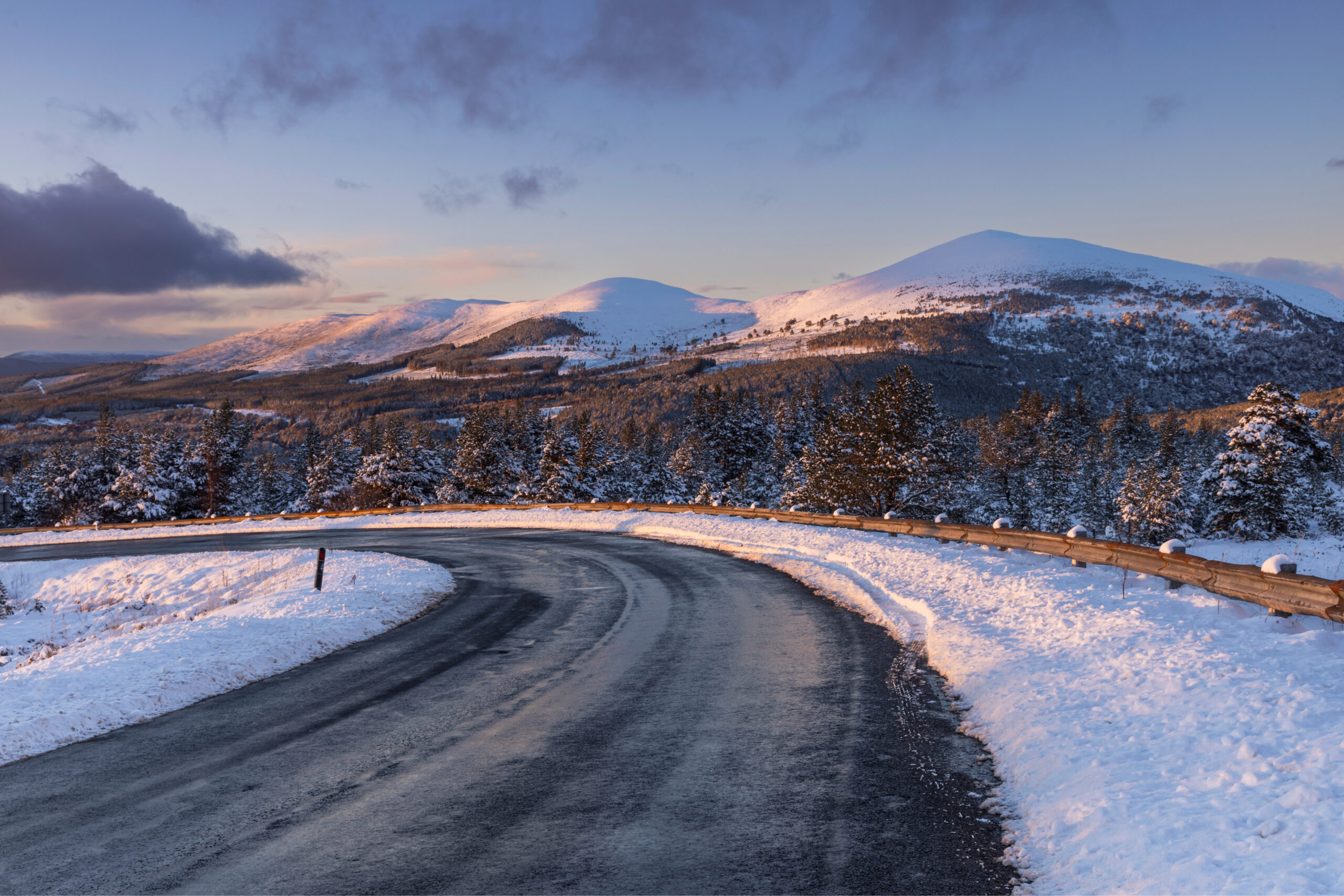
The Cairngorms are home to the highest and most arctic landscape in Britain. The plateau above 1,000 metres is genuinely dangerous in winter and the domain of experienced mountaineers. But the lower routes through the ancient Caledonian pine forests and along the river valleys offer winter walking that is both safe and spectacular.
The path from the Loch an Eilein car park near Aviemore follows the shoreline of a beautiful loch with a ruined castle on an island at its centre. In winter, the Scots pines along the shore are often dusted with snow, and the loch itself can freeze around the edges. Red squirrels are active here year-round, and with fewer people and less foliage, winter is actually the best time to spot them.
For a slightly longer walk, the route through Rothiemurchus Forest to the foot of the Lairig Ghru, the great mountain pass that cuts through the Cairngorms, gives a genuine sense of entering a wilder world. The ancient pines, some of them hundreds of years old, stand widely spaced on the forest floor, and in winter, with snow on the ground and the peaks above hidden in cloud, this forest has a stillness that feels almost sacred.
Winter Walks at a Glance
| Walk | Region | Distance | Difficulty | Highlights |
|---|---|---|---|---|
| Catbells | Lake District, England | 4 miles (6.4 km) | Easy to moderate | Ridge views over Derwentwater, panoramic summit |
| Mam Tor Ridge | Peak District, England | 5 miles (8 km) | Moderate | Great Ridge walk, views above the clouds |
| Llyn Idwal | Eryri, Wales | 3 miles (5 km) | Easy to moderate | Glacial lake, frozen waterfalls, Darwin heritage |
| Ben Nevis Lower Path | Scottish Highlands, Scotland | 6 miles (10 km) | Moderate | Snow-capped peaks, Highland valley views |
| Pen y Fan | Brecon Beacons, Wales | 4 miles (6.4 km) | Moderate | Highest peak in southern Britain, temperature inversions |
| Hadrian’s Wall Path | Northumberland, England | 4 miles (6.4 km) | Easy to moderate | Roman frontier, Housesteads Fort, Whin Sill ridge |
| Causeway Coast Path | Causeway Coast, Northern Ireland | 10 miles (16 km) | Moderate | Giant’s Causeway, White Park Bay, basalt columns |
| Wicklow Way (Glendalough) | Wicklow Mountains, Ireland | 4 miles (6.4 km) | Easy to moderate | Monastic ruins, Upper Lake, mountain scenery |
| Lulworth to Durdle Door | Jurassic Coast, England | 2 miles (3.2 km) | Easy to moderate | Natural rock arch, fossil coast, chalk cliffs |
| Loch an Eilein | Cairngorms, Scotland | 4.5 miles (7 km) | Easy | Ancient pine forest, castle island, red squirrels |
Practical Advice for Winter Walking
Daylight Hours
The single biggest factor in winter walking is the short day. In December, parts of northern Scotland receive as little as six hours of daylight, and even southern England manages only around eight. This is not a reason to stay indoors, but it does mean planning your day carefully.
Key points:
- Check sunrise and sunset times for your specific location before setting out
- Aim to start walking within an hour of first light to make the most of the day
- Allow a generous time buffer, as winter paths can be slower underfoot
- Carry a headtorch as a non-negotiable safety item, even on short walks
- Plan shorter routes than you would attempt in summer
Kit Essentials
Winter walking does not require a vast amount of specialist gear, but getting the basics right makes the difference between enjoyment and misery.
What to carry:
- Waterproof jacket and trousers: breathable fabrics are worth the investment
- Warm layers: a merino base layer, insulating mid-layer, and windproof outer
- Hat, gloves, and a neck gaiter or buff: most heat is lost through the head and extremities
- Waterproof boots with ankle support and good grip on wet or icy surfaces
- Microspikes or trail crampons for icy paths, particularly on higher ground
- A flask of hot tea or coffee: the psychological boost is real
- Map and compass as backup, even if you use a phone GPS
- Headtorch with spare batteries
- Emergency shelter or bivvy bag on mountain walks
Safety in Winter
Winter conditions in the British hills can change rapidly. A clear morning can become a whiteout within an hour, and what looks like a gentle slope on the map may be iced over and treacherous underfoot.
Essential safety considerations:
- Always check the weather forecast before setting out: the Met Office mountain forecast and MWIS (Mountain Weather Information Service) are the most reliable sources for upland areas
- Tell someone where you are going and when you expect to return
- Be prepared to turn back if conditions deteriorate: the mountain will still be there tomorrow
- Avoid walking alone in remote mountain areas in winter unless you are very experienced
- Carry enough food and water for longer than you expect to be out
- In Scotland, check the Scottish Avalanche Information Service (SAIS) reports before heading onto the higher mountains
Checking Conditions
Several resources will help you plan a safe and enjoyable winter walk:
- Met Office mountain weather forecasts cover all major upland areas in England, Wales, and Scotland
- MWIS (Mountain Weather Information Service) provides detailed forecasts for specific mountain areas
- SAIS (Scottish Avalanche Information Service) publishes daily reports through the winter season, typically from December to April, for the main Scottish mountain areas
- National park websites and local walking groups often post recent condition reports and trail updates
- Social media groups for specific areas, such as the Lake District or Eryri, frequently share real-time conditions and photographs
Planning a Winter Walking Trip
One of the great pleasures of a winter walking holiday in Britain and Ireland is the rhythm of it: a brisk morning on the hill followed by an afternoon in a warm pub, a country house hotel, or a cottage with a log fire. The shorter days lend themselves to a pace that balances outdoor adventure with genuine rest and comfort.
Great British Trips can arrange tailor-made winter walking itineraries that take the logistics off your hands. Whether you want a week-long tour connecting several of these walks with characterful accommodation, or a long weekend focused on a single region, the team can put together a trip built around your interests, fitness level, and the kind of experience you are looking for. Transfers between walks, accommodation with real character, and local recommendations are all part of what a well-planned itinerary delivers.
Winter walking in Britain is not about ticking off summits or covering maximum distance. It is about slowing down, looking more carefully, and discovering that these islands have a beauty in the cold months that the summer brochures never show you.
If you would like a winter walking trip planned around you, request a quote and the team will build it with you.
Frequently Asked Questions
Is winter walking in Britain safe for visitors?
Winter walking in Britain is safe and enjoyable provided you choose routes appropriate to your experience and prepare properly. The walks in this guide range from gentle lakeside paths to moderate hill routes, and none require technical mountaineering skills. Winter summits such as Ben Nevis are serious mountaineering and are not covered here. The key is to check the weather forecast, carry the right kit, start early to make the most of daylight, and be willing to adjust your plans if conditions change. For higher-level mountain walks, hiring a local guide is a sensible option if you are unfamiliar with winter conditions in British hills.
What is the best month for winter walking in Britain?
Each winter month has its own character. November brings moody skies and the last of the autumn colour at lower levels. December and January offer the best chance of snow and frost on higher ground, along with the most dramatic short-day light. February often brings the clearest skies and the first hints of lengthening days. There is no single best month; it depends on whether you want snowy summits, frosty forests, or storm-lashed coastline. All are rewarding.
Do I need special equipment for winter walks?
For the lower-level and coastal walks in this guide, sturdy waterproof boots, warm layers, waterproofs, hat, gloves, and a headtorch are sufficient. For higher routes such as Pen y Fan, Mam Tor, or the Ben Nevis lower path, carrying microspikes is strongly recommended as paths can be icy. A map, compass, and charged phone with offline maps are sensible on any walk. You do not need crampons or ice axes for the routes described here, though anyone venturing onto higher Scottish mountains in winter should carry them and know how to use them.
Can I combine winter walking with other experiences?
Absolutely. One of the joys of a winter trip to Britain and Ireland is the combination of outdoor activity with cultural experiences and exceptional food and drink. Many of the walks in this guide are within easy reach of historic sites, distilleries, market towns, and outstanding restaurants. A morning on Hadrian’s Wall pairs naturally with an afternoon at a Northumberland country pub. A walk around Loch an Eilein can lead to a whisky distillery visit in Speyside. Great British Trips specialises in building itineraries that weave together walking, culture, and comfort.
Are these walks suitable for families?
Several of the walks in this guide are suitable for families with children who are comfortable walking for a couple of hours. Catbells in the Lake District, the Loch an Eilein loop in the Cairngorms, the Lulworth Cove to Durdle Door section of the Jurassic Coast, and the Glendalough lakeside walk in Wicklow are all manageable for older children. The key with families in winter is to keep distances short, pack plenty of snacks and hot drinks, and have a warm destination in mind for afterwards. A hot chocolate in a village cafe is as much a part of the experience as the walk itself.