
Britain’s Best Spa Towns and Wellness Retreats
Long before wellness became a global buzzword, the people of Britain and Ireland were soaking in mineral-rich waters, breathing in sulphurous steam, and believing wholeheartedly in the healing power of a good hot spring. The tradition stretches back to the Romans, who built elaborate bathhouses wherever they found thermal waters bubbling up from the earth. Centuries later, Georgian and Victorian society turned “taking the waters” into an art form, and elegant spa towns sprang up across Britain and Ireland, complete with pump rooms, promenades, and the kind of grand architecture that makes you want to walk a little slower and stand a little taller.
Today, these historic spa towns are enjoying a revival. Modern wellness retreats sit alongside centuries-old thermal baths, and a new generation of travellers is discovering that Britain and Ireland offer some of the most distinctive spa experiences anywhere in Europe. Whether you want to float in rooftop thermal pools with views of honeyed Georgian crescents, sweat it out in a restored Victorian Turkish bath, or disappear into the green silence of an Irish country estate, there is something here that goes far deeper than a standard hotel spa.
This guide takes you through the finest spa towns and wellness destinations across England, Wales, Scotland, Northern Ireland and the Republic of Ireland, with practical tips for planning a trip that balances relaxation with exploration.
The Roots of British Spa Culture
The story begins with the Romans. When they arrived in Britain in AD 43, they quickly identified the thermal springs at what is now Bath and constructed a bathing complex of extraordinary ambition. The Great Bath, fed by water that falls as rain on the Mendip Hills and rises through limestone at a temperature of around 46 degrees Celsius, became the social and spiritual heart of the settlement they called Aquae Sulis.
After the Romans departed, the bathing tradition faded for centuries, but it never entirely disappeared. By the 17th and 18th centuries, a new enthusiasm for mineral waters swept through British society. Physicians prescribed “the waters” for everything from gout to melancholy, and towns with natural springs competed to attract wealthy visitors. Pump rooms were built for drinking the waters (an acquired taste, by most accounts), assembly rooms for dancing, and elegant terraces for the all-important business of seeing and being seen.
The Victorians took things further still, adding Turkish baths, hydrotherapy treatments, and the kind of civic pride that produced some of Britain’s most handsome public buildings. By the early 20th century, the fashion had shifted and many spa towns fell into gentle decline. But the buildings remained, the springs kept flowing, and in recent decades the old spa towns have reinvented themselves for a world that is once again passionate about wellbeing.
England’s Great Spa Towns
Bath, Somerset
No survey of British spa culture can begin anywhere other than Bath. The city is itself a UNESCO World Heritage Site, and the relationship between its architecture, its history, and its thermal waters is inseparable. The Roman Baths are among the best-preserved ancient bathing sites in northern Europe, and while you can no longer swim in them, the museum that surrounds them is absorbing.
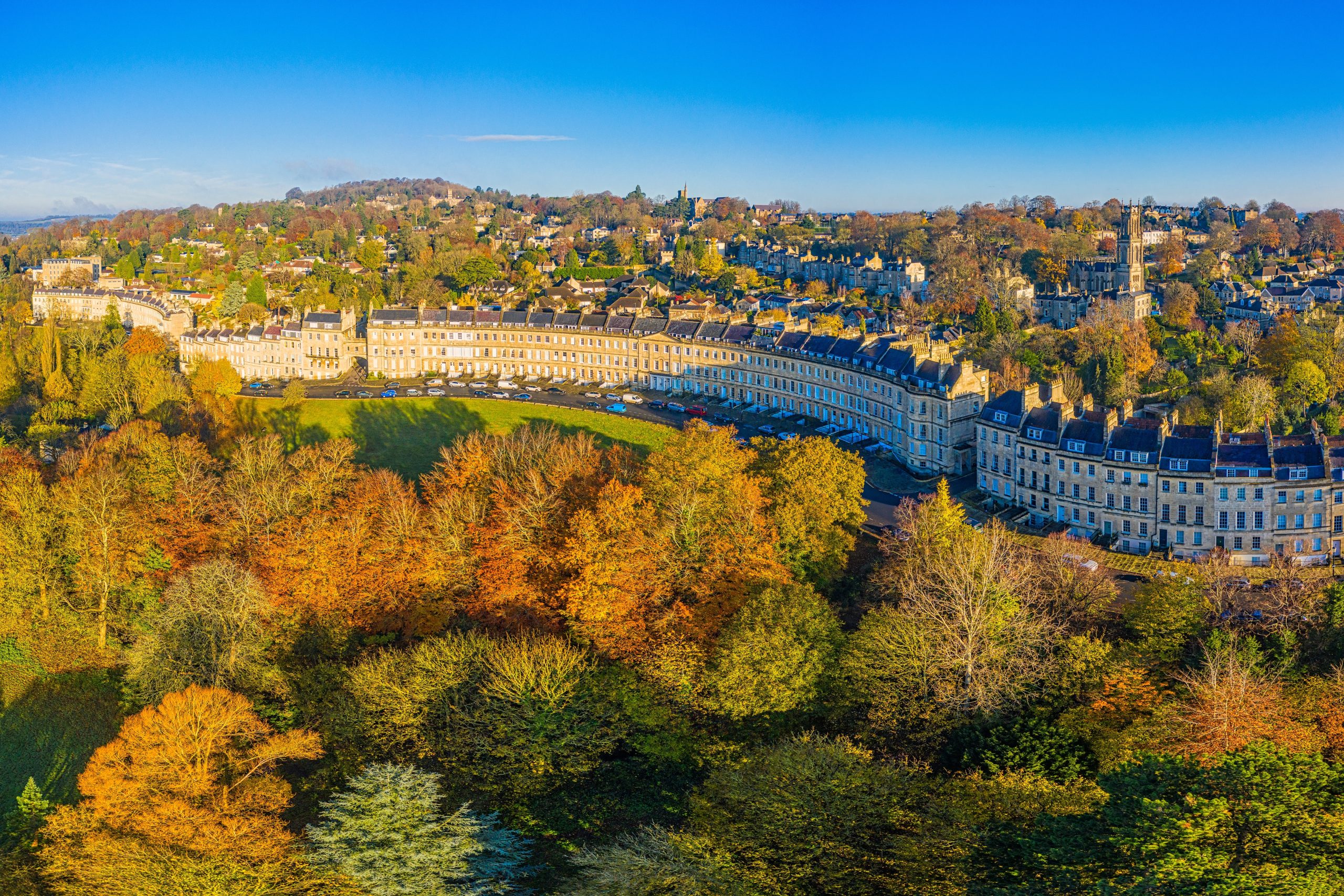
For a modern bathing experience, Thermae Bath Spa is the place. Opened in 2006 and built around the original hot springs, it is one of the few places in Britain where you can bathe in naturally warm, mineral-rich water. The rooftop pool is the standout: an open-air thermal bath with steam rising from the surface and views across the city to the Abbey, the Royal Crescent, and the green ring of surrounding hills. On a winter evening, with the city lights below and the warm water around you, it is genuinely magical.
Thermae Bath Spa also offers a Minerva Bath (the main indoor pool), a series of aromatic steam rooms infused with essences like eucalyptus and frankincense, and a range of spa treatments. The Cross Bath, a smaller and more intimate open-air pool in a separate building nearby, can be booked privately for groups.
Beyond the spa, Bath rewards unhurried exploration. The Royal Crescent, the Circus, Pulteney Bridge, and the Jane Austen Centre are all within easy walking distance. The surrounding countryside, including the Cotswolds to the north and the Mendip Hills to the south, is excellent for day trips.
Harrogate, North Yorkshire
Harrogate built its reputation on water: iron-rich, sulphur-laced water that visitors flocked to drink and bathe in throughout the 18th and 19th centuries. The Royal Pump Room Museum, housed in the octagonal building where visitors once queued to sample the waters, tells this story well. You can still taste the sulphur water there, though fair warning: it is spectacularly unpleasant.
The real draw today is the Turkish Baths, a beautifully restored Victorian bathhouse that has been in operation since 1897. The interior is a riot of decorative tilework, painted ceilings, and Moorish arches, and the experience follows the traditional progression: warm room, hot room, steam room, plunge pool. It is both a genuine historical experience and a deeply relaxing one. Evening sessions, when the baths are quieter and the tiled rooms glow under low lighting, are particularly atmospheric.
Harrogate itself is a handsome town with broad tree-lined streets, independent shops, and the vast green expanse of the Stray. The Yorkshire Dales are right on the doorstep, making it easy to combine a spa visit with walks through some of England’s finest upland scenery.
Buxton, Derbyshire
Tucked into the hills of the Peak District, Buxton has been a spa destination since Roman times, though it was the fifth Duke of Devonshire who gave the town its Georgian elegance in the late 18th century. The Crescent, a sweeping curve of Grade I listed buildings modelled on Bath’s Royal Crescent, was restored and reopened in 2020 as a hotel and thermal spa.
Buxton Crescent Hotel and Thermal Spa draws its water from the same source that has attracted visitors for two millennia: a natural thermal spring that emerges at 28 degrees Celsius. The spa includes a large thermal pool, smaller treatment pools, and a range of water-based therapies. The setting, inside the restored Crescent with its high ceilings and period detail, gives the experience a sense of occasion.
The town is also the gateway to the Peak District National Park, with walking trails, limestone dales, and the dramatic caverns of Poole’s Cavern all within easy reach. The Buxton Opera House, a perfect Edwardian theatre, hosts a year-round programme of performances.
Droitwich Spa, Worcestershire
Droitwich is one of England’s lesser-known spa towns, but it has a remarkable claim: its brine springs are among the most saline natural waters in the world, with a salt concentration roughly ten times that of seawater. The effect is similar to floating in the Dead Sea, and the town has been exploiting this natural resource since at least the Roman period.
The Droitwich Spa Lido, originally opened in 1935, has long used natural brine water in its outdoor pool. Floating effortlessly in salt-dense water on a summer afternoon is an experience quite unlike anything else in Britain. A major upgrade of the lido has been planned, so check its current opening status before you travel.
Droitwich sits in the Worcestershire countryside between Birmingham and Worcester, close to the Malvern Hills and the Vale of Evesham. It is a good base for exploring a quietly beautiful part of the English Midlands.
Cheltenham, Gloucestershire
Cheltenham’s spa heritage dates to 1716, when pigeons were observed pecking at salt deposits around a local spring. The town rapidly developed into one of the most fashionable spa resorts in England, and the legacy is visible in its wide Regency boulevards, ornamental gardens, and the elegant Pittville Pump Room, where you can still taste the mineral water.
While Cheltenham is better known today for its racecourse, its literary and music festivals, and its position on the edge of the Cotswolds, the wellness tradition persists. Several high-quality hotel spas operate in and around the town, and the Pittville Pump Room itself is one of the finest examples of Regency architecture in the country.
The town makes an excellent base for exploring the Cotswolds, with honey-stone villages, rolling wolds, and country pubs scattered across the surrounding countryside.
Wales: Llandrindod Wells
In the green heart of mid-Wales, Llandrindod Wells is a Victorian spa town that feels like a step back in time. The town grew up around its chalybeate (iron-bearing), sulphur, and saline springs, and at its peak in the late 19th century it attracted thousands of visitors each year. The legacy is a town of handsome Victorian buildings, a boating lake, and wide streets that feel generously proportioned for a settlement of its size.
The town’s Rock Park, home to the original spa buildings, still offers visitors the chance to sample the chalybeate spring water, while the surrounding area is rich in outdoor activities. The Elan Valley, a chain of reservoirs set in wild upland scenery often compared to the Lake District, is a short drive away. Red kites, once almost extinct in Britain, circle overhead in large numbers.
Llandrindod Wells is a quieter, more contemplative kind of spa destination, well suited to travellers who want to slow down and immerse themselves in the Welsh landscape.
Scotland: Strathpeffer
North of Inverness, in the shadow of Ben Wyvis, the village of Strathpeffer was once the most fashionable spa resort in the Scottish Highlands. Victorian visitors arrived by train to take the sulphur and chalybeate waters, and the grand hotels and ornate pavilion they left behind give the village an unexpected elegance.
The restored Victorian Upper Pump Room is where you can learn about the town’s spa history and sample the mineral waters. The surrounding landscape is spectacular: the Highlands stretch away in every direction, with lochs, mountains, and ancient Caledonian pine forests within easy reach.
Strathpeffer works beautifully as part of a broader Scottish Highlands itinerary starting from Inverness, offering a point of historical and cultural interest alongside the natural drama of the landscape. The village is well placed for visits to the Black Isle, Loch Ness, and the North Coast 500 route.
Wellness Retreats in Ireland and Northern Ireland
Monart Destination Spa, County Wexford, Republic of Ireland
Monart occupies a different place in the wellness landscape. This is not a historic spa town but a purpose-built destination spa set on 100 acres of woodland and gardens in the gentle countryside of southeast Ireland. It is widely regarded as one of the finest spa retreats in Europe.
The approach at Monart is total immersion. There are no children under 18, and the atmosphere is one of deliberate, unapologetic calm. The thermal suite includes a salt grotto, a cedar sauna, outdoor hot tubs, and a series of experience showers. Treatments draw on both traditional and contemporary techniques, and the emphasis is on extended stays rather than quick visits.
The surrounding area offers plenty for those who want to explore between treatments. The medieval town of Wexford, the beaches of the Hook Peninsula, and the Wicklow Mountains to the north all make rewarding day trips.
Lough Erne Resort, County Fermanagh, Northern Ireland
In the lakelands of County Fermanagh, Lough Erne Resort sits on a peninsula between Upper and Lower Lough Erne. The Thai Spa here is one of the most distinctive in Britain and Ireland, drawing on Southeast Asian wellness traditions in an unmistakably Irish setting.
The spa includes an infinity pool overlooking the lough, an extensive thermal suite, and treatments delivered by Thai therapists trained in traditional techniques. The juxtaposition of the misty Fermanagh lakelands outside and the warm, aromatic treatment rooms inside is striking.
Beyond the spa, the Fermanagh Lakelands are one of the most underrated regions on the island of Ireland. The Marble Arch Caves, the island monasteries of Lough Erne, and the quiet waterways that wind through the countryside all reward exploration.
Practical Information
What to Expect at a British Spa
| Spa Type | Typical Features | Price Range | Best For |
|---|---|---|---|
| Historic thermal baths | Natural mineral water pools, steam rooms, cold plunge | 20 to 50 GBP for 2 to 4 hours | Experiencing living history |
| Victorian Turkish baths | Heated rooms, steam, plunge pools, traditional progression | 15 to 30 GBP per session | Atmospheric relaxation |
| Destination spa resorts | Full thermal suites, treatment menus, overnight stays | 150 to 400 GBP per night | Extended wellness breaks |
| Town spa centres | Indoor pools, saunas, treatment rooms | 10 to 40 GBP per visit | Casual day visits |
Prices are approximate and change through the year, so check before you book.
Booking Tips
- Thermae Bath Spa in Bath and the Turkish Baths in Harrogate are popular year-round. Booking at least two weeks ahead is advisable, especially for weekend and evening sessions.
- Midweek visits are generally quieter and sometimes cheaper. Tuesday to Thursday tends to offer the best balance of availability and atmosphere.
- For destination spas like Monart, booking several months in advance is recommended, particularly for weekends and bank holidays.
- Many spa towns offer combination tickets or passes that include both the spa experience and entry to local museums or historic sites. Ask when booking.
- If you are visiting in winter, pack a warm robe or cover-up for moving between outdoor and indoor pools. Most spas provide robes, but it is worth confirming.
Combining Spa Visits with Sightseeing
One of the great advantages of Britain’s spa towns is that they are invariably set in places worth exploring in their own right. A spa visit need not be a single-purpose trip.
- A morning at Thermae Bath Spa pairs naturally with an afternoon exploring the Roman Baths, the Abbey, and the independent shops along Walcot Street.
- The Turkish Baths in Harrogate sit within walking distance of the town centre and a short drive from Fountains Abbey and the Yorkshire Dales.
- Buxton combines thermal bathing with walks in the Peak District, making it ideal for travellers who want both activity and relaxation.
- Strathpeffer can anchor a Highlands road trip, offering a cultural pause between days of dramatic scenery.
Weekend Itinerary Ideas
A two-night spa weekend in Bath might look like this: arrive Friday afternoon and check into a hotel in the city centre. Spend the evening at Thermae Bath Spa, finishing with time in the rooftop pool as the sun sets. Saturday morning, visit the Roman Baths and the Pump Room for coffee, then walk along the canal towpath or drive out to the village of Castle Combe in the Cotswolds. Sunday, return to the spa for a treatment before a late lunch and a stroll through the Royal Victoria Park.
In Ireland, a three-night stay at Monart allows for a full day of spa immersion, a day trip to the coast at Hook Head or the Saltee Islands, and a final morning of treatments before departure. The pace is deliberately unhurried, and the setting encourages it.
Tailor-Made Wellness Itineraries
For travellers who want to weave spa experiences into a broader tour of Britain or Ireland, Great British Trips can build tailor-made itineraries that combine wellness stops with cultural sightseeing, countryside walks, and local dining. Whether you want a single spa day folded into a week-long tour or a dedicated wellness circuit visiting several of the destinations in this guide, the team can handle the logistics, from hotel bookings and spa reservations to transport and local recommendations. If you would like us to build one for you, request a free quote and tell us where you would like to unwind.
Frequently Asked Questions
Do I need to book spa visits in advance?
For popular sites like Thermae Bath Spa and the Harrogate Turkish Baths, advance booking is strongly recommended, especially for weekends, bank holidays, and evening sessions. Smaller or less well-known spas may accept walk-ins, but checking ahead is always wise.
Are British spa experiences suitable for families?
It depends on the venue. Many public spas welcome children above a certain age (usually 12 or 16), while destination spa resorts like Monart are adults only. The Droitwich Spa Lido, with its unique brine water, has traditionally been a popular option for families in summer, though you should check its current opening status first. Always check the age policy before booking.
What should I bring to a spa visit?
Most spas provide towels, robes, and slippers, but it is worth confirming when you book. You will need swimwear for all pool and thermal suite areas. Flip-flops or pool shoes are useful. Leave jewellery at home or in your hotel safe, as mineral water can tarnish metals over time.
When is the best time of year to visit British spa towns?
There is no bad time. Winter visits have a particular appeal: stepping from a cold, crisp day into a warm thermal pool is one of life’s simple pleasures. Spring and autumn are ideal for combining spa visits with walking and sightseeing, as the weather is mild and the towns are less crowded. Summer brings longer days, outdoor pools, and the chance to enjoy spa town gardens at their best.
Can Great British Trips arrange a multi-stop spa itinerary?
Yes. Great British Trips specialises in tailor-made touring across Britain and Ireland. The team can design itineraries that link several spa towns and wellness destinations, arranging accommodation, transport, spa bookings, and sightseeing along the way. Get in touch to discuss what you have in mind.